
Uniform Coating, Regardless of Geometry
Electroless nickel plating is a processing method used to deposit a layer of nickel-phosphorus alloy on a metal or plastic part. Alloys with different percentages of phosphorus are possible, ranging from 2–5% (low phosphorus) up to 11–14% (high phosphorus). The metallurgical properties of the alloy depend on the percentage of phosphorus.
Electroless nickel plating is an auto-catalytic reaction used to deposit a coating of nickel on a substrate. Unlike electroplating, it is not necessary to pass an electric current through the solution to form a deposit. This plating technique is employed to prevent corrosion and wear.
Advantages Over Electroplating
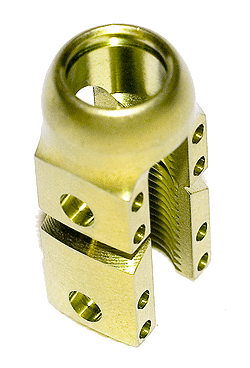
Electroless nickel plating has several advantages versus electroplating. Free from flux-density and power supply issues, it provides an even deposit regardless of component geometry — and, with the proper pre-plate catalyst, can deposit on non-conductive surfaces.
Because electroless nickel plating produces a non-toxic coating, it is commonly used in medical devices. Other applications include optical surfaces for diamond turning, electrical and mechanical tools, and various industrial equipment.